

This week’s Daft Punk climate headline (harder, better, faster, stronger), - Bananas in Essex! Local banana fan surprised by his collection of 200 banana plants suddenly flowering and producing fruits.
There is a reason why the variety of banana that Eric grows1 is not a thing you have heard of - the Musa Basjoo - and that would be that they are totally inedible. It’s the Cavendish that we know from the supermarket, but still, props to Bananaman. His passion is growing the not-a-tree and he has been rewarded for his efforts.
Six or seven years ago, I bought a novelty baby banana tree in a 15cm pot. The nurseryman and I knew each other a bit, and he scoffed gently, wasting my money on silly things. He had me down as a serious buyer of serious plants, I think. He said “well, you’re welcome, but it won’t last the winter”. “I know, but its a bit of fun - zum Spass”. He took my money, and we all left happy.
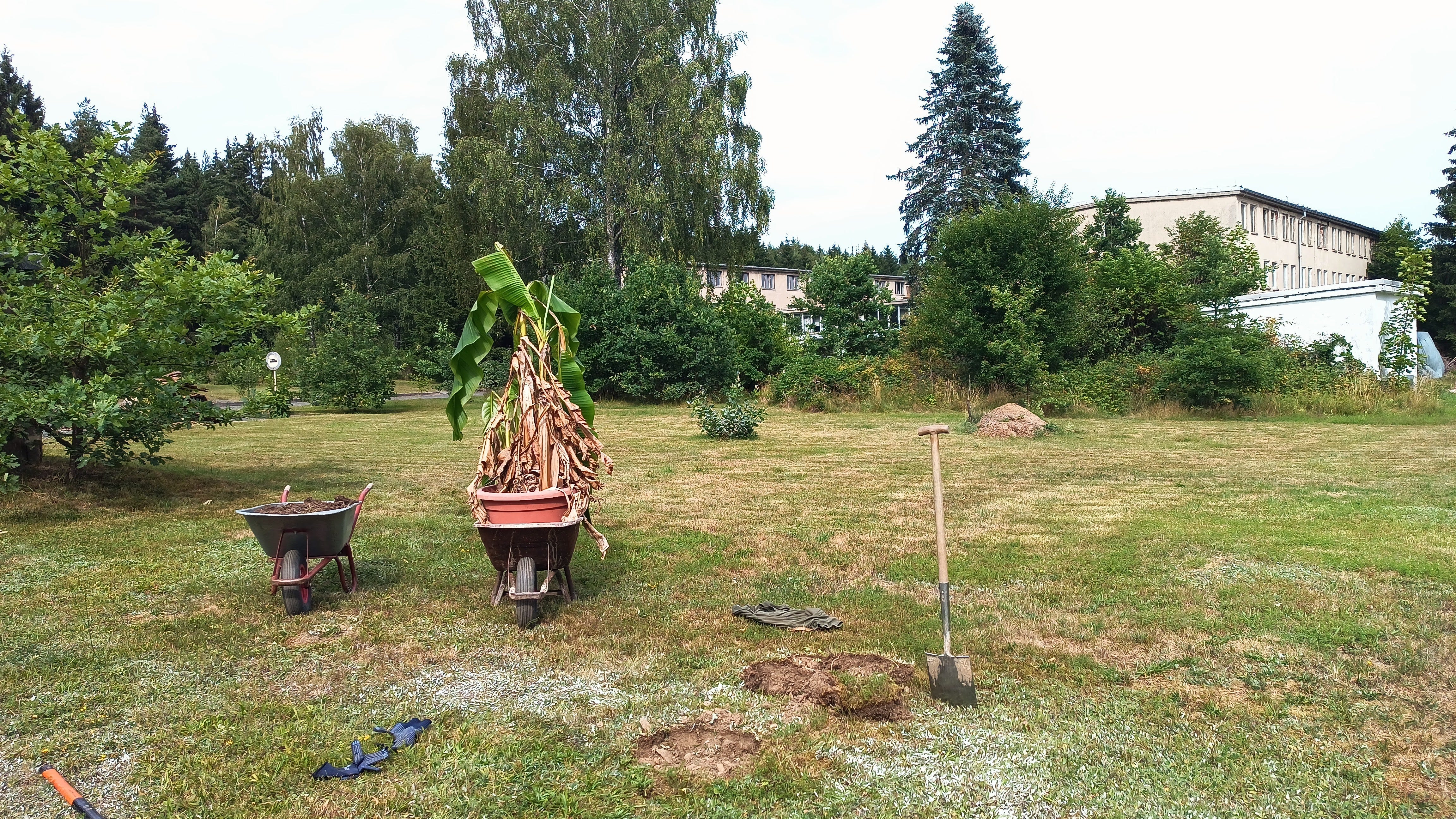
Since then, I have repotted it a bunch of times, and yesterday it stood at about 1m20 tall, in a 60cm pot, surrounded by it’s own baby clones. I bring it inside every winter where it is perfectly happy in very subdued light and night-time temperatures of around 5C for much of the winter. Or in other words, an ideal hibernation situation. When we are long past the most pessimistic of frost chances, I bring it outside to sit proudly on the loft porch. It gets a damn good watering after being drip-fed all through the long dark days, and enjoys many full hours of sunshine.
For at least the last two years, and especially this one, it’s been harder to hokey cokey it from the in to the out without damaging some of the leaves. For one, it’s pretty heavy and unwieldy, for another, the loft was not designed for lumping around giant herbaceous plants. The doors specifically are narrow, low and metal. I assume that the architectural considerations for easy in- and egress whilst carrying banana plants is antithetical to siege warfare.
Or in other words, I had decided back in Spring that I was going to plant out the bananas. I have no idea what variety they are - almost certainly basjoos not cavendishes, but we shall see. And honestly, I hope to all the gods, the old and the new, that they never flower and never bear fruit. Obviously, I will be doing everything I can to ensure that they survive the winter - cut all the leaves off, cover the stalks in bubble wrap, and encase the whole thing in about 6 foot of straw and cover with the biggest heaviest tarps that I have.
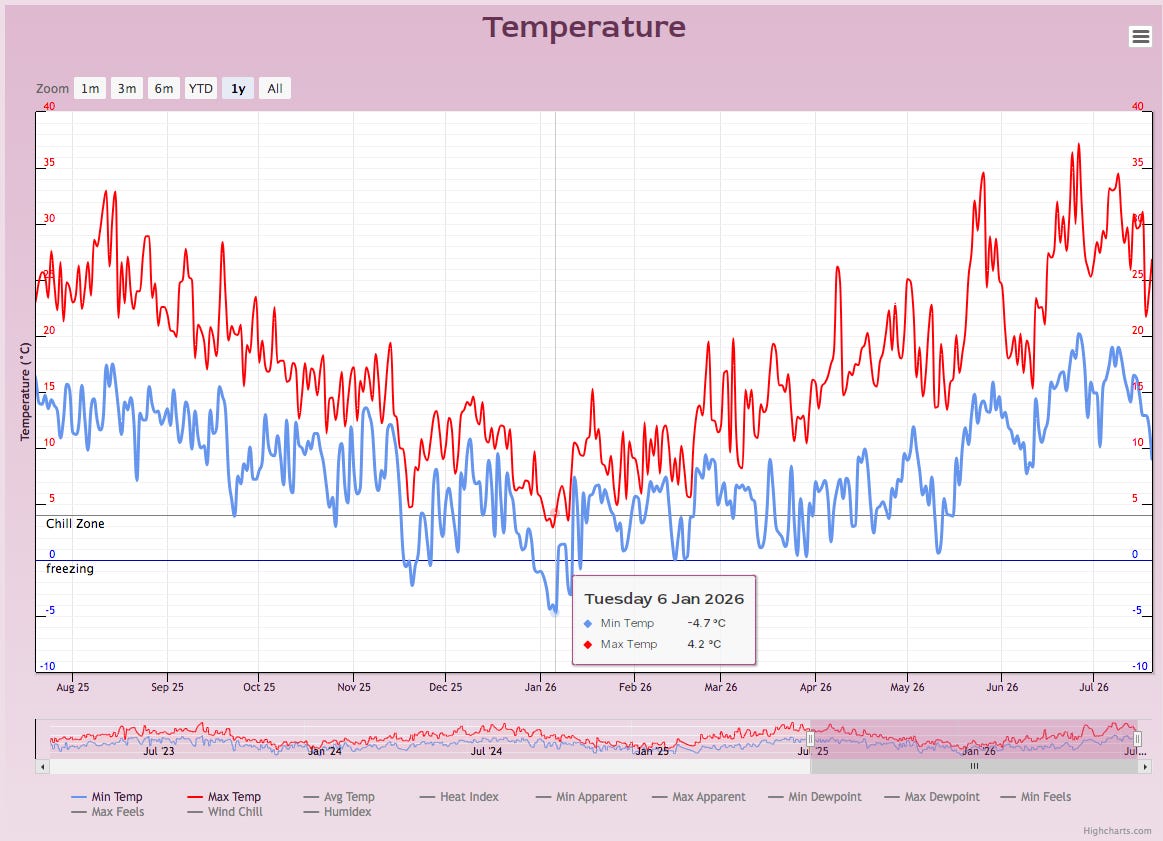
But I found the temperature chart for our man in Essex and it’s not good. Sure, he has bananas that he can’t eat, and only two nights, maybe three, below freezing, but he might well not be able to grow apples.
The best of the tree fruits of Europe all require chill hours - apples, peaches, cherries and plums, all of which need to go to sleep in the winter and for that they need up to 1000 hours between 0 and 7C. I’ve not spent a great deal of time analysing the chart for Rayleigh, but I’m pretty sure there aren’t enough cold hours to grow even pears of apricots which can do with about 500 chill hours. You don’t need to either. The graph shows the red line for the hottest temperature on a given day, and a blue line for the lowest. So the total temperature for the day is the area between the two lines. There are 8760 hours in a year. Does this graph look like about an eighth of the area between the lines is under the Chill line? Not to me it doesn’t. 2
We’ve all been disappointed in the mainstream press and it’s reporting on the future effects of the coming climate apocalypse. The banana story was widely reported, with the tone of a quirky feel good tale or bananas. LoL. I didn’t see a single report about Eric written by a journalist engaged enough to wonder aloud if there might be wider implications for the food that we eat. And this in the same week where the farming press is worried that the wheat harvest is too dry to be useful and the first murmurings of food security as a potential political issue are starting to rise to a whisper. Ten, twenty years too late, but still.
That is, whispers in the West. China has years of food reserves. No-one outside the People’s Republic knows much, of course, but they could easily have a decade’s worth of grain reserves in massive silos. Russia, Iran and India have plenty. Switzerland is the most progressive of all the Western nations, mandating a 3 month supply of wheat, sugar and coffee, so the important stuff first. Nothing is said about what happens after three months. No-one else has anything. Literally nothing. Britian, Germany, France - maybe three days each. And you know what? It’s really frikkin easy. I am well on the way to building up a rolling seven years’ of grain reserves - I reckon it takes seven years to get there. And I did that by accident. Just good, sensible use of the land and a general understanding that market forces are literally the worst answer to any given question.
Quit your job, get out of the city. Join a self-sufficient community. Buy a farm. Move to the land. Do it today.
I won’t have any of you saying it was a surprise.
Just do your best, eh, folks?
Much pirate love
Your loving Pirate Ben
xoxo
His name is Peter, not Eric.
This isn’t exactly how graphs work, but for a quick visual analysis, it’s going to give an answer somewhere close to the one we are looking for. I would say barely a twentieth of it falls under the Chill line
Seems like your way of doomerism is collapsing too. I don’t like that for both of us.